


The Placebo Effect is a phenomenon that receives less than its fair share of attention from not only the scientific community but from the average person on the street. The implications of a placebo point towards our own consciousness being a powerful manipulator of our experience of reality; a paradigm shattering revelation that is brushed over as insignificant by far too many.
If your thoughts are so powerful that they can manifest as physical actions within the body why has so much effort been placed on attempting to alter physiology through extrinsic means? If the ability to intrinsically alter our body, for the better, is indeed possible why is there not more research dedicated to the matter?
The answer is quite simply, money. There exists little financial incentive for entrepreneurs to invest in what is essentially an individualistic endeavor. If a person can heal themselves with his or her own thoughts they then become free of the need of any external influence. There are no products one can sell to a person who is self sufficient.
Modern science is fueled by research grants from organizations who see the grant as an investment. No potential for money results in little to no research on the topic in question. By now the current state of the health industry begins to take shape, as most well funded and researched topics are those that provide the best monetary returns. More people are in the field of disease management than health promotion.
You and I can heal ourselves through the the power of our own minds. How this power can precisely be harnessed is still in question.
Proof For a Placebo
Before we ask the question of how we must first ask what? What exactly is a placebo and what does current evidence say regarding the existence and reach of the phenomenon?
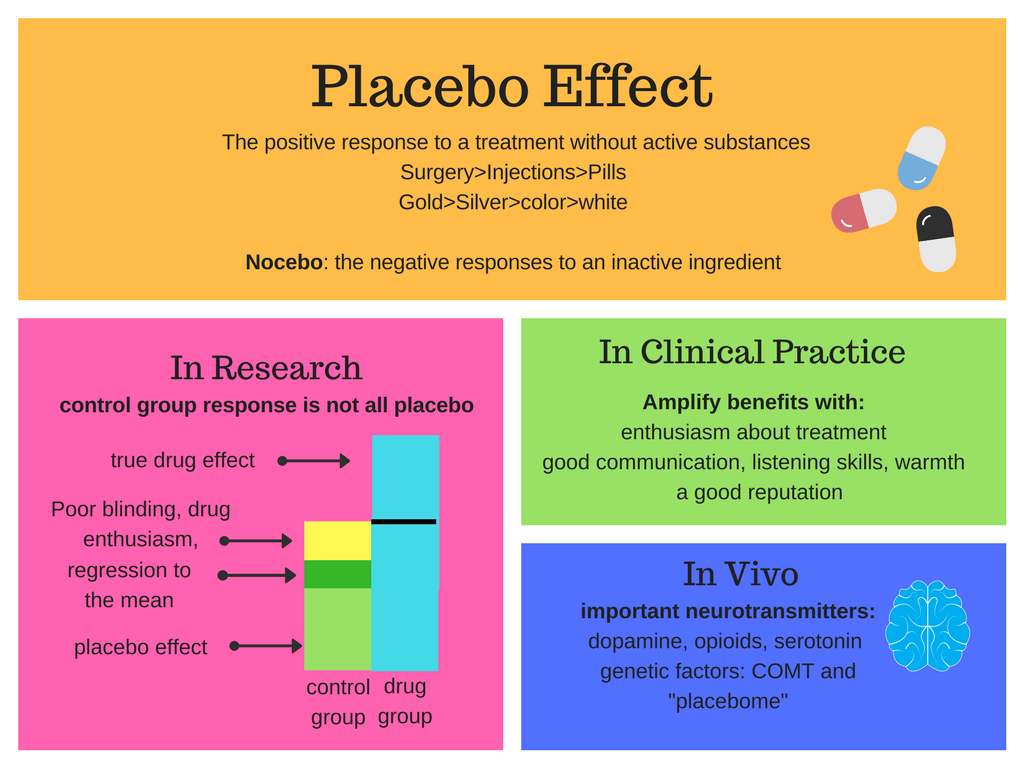
Literally anything can act as a placebo, from a sugar pill to a phony medical device, the “magic” lies in the belief of the individual. Although the origin is not precisely known, it is the concept of a placebo has been around for thousands of years. The word comes from the Latin “I shall please”, coined in the 18th century by European physicians. The term was meant to describe the positive psycho-physical effect of the doctor on the patient. These physicians noticed that often times the most effective treatment that they could prescribe to their patients was their own presence, and the reassurance that came with it.
From the 20th century to the modern day, the placebo effect has been used as a benchmark for the effectiveness of pharmaceutical compounds and other modalities. If a substance or therapy performed better than the placebo it was considered successful. The nearly 1 trillion dollar industry of modern pharmaceuticals is founded on this practice.
Spectrum of Effects
The range of effects from a placebo are an area of debate. Some claim the ability to cure chronic diseases such as cancer, others attest to its ability to ease pain, and more speak of its role in easing depression. Because of the difficulty of study, little legitimate long term research exists on placebos and curing disease. That said, there is anecdotal evidence of such seemingly miraculous events occurring. Though these events are indeed rare, it is equally rare for doctors to treat with these methods.
Although there is also proof of blatant physiological changes (blood pressure, heart rate, other blood values) it is currently believed that placebos have their greatest benefit where the mind and body meet (). This primarily boils down to an individual’s perception of his or her life events including psychological, and physical pain. Confounded by growing evidence, it seems as if placebos can alter depression, anxiety, and pain through alterations in our own physiology. Increased opioid activity within the brains of depressed individuals, altered dopamine in the brains of sufferers from restless leg syndrome, as well as the reduction of pain — equivalent to those administered morphine — are all documented in scientific literature().
Nocebo
The opposite of a placebo is known as a “nocebo”. This is a treatment that actually harms a patient despite the lack of active ingredients. Examples include patients being told that an inert cream was going to induce pain, only to experience discomfort after administration. The nocebo is but another example of the power of one’s expectations. Negative thought patterns translate into negative physical repercussions, exactly how is unknown.
All is Mind
It was not until relatively recently that we have garnered a better understanding of the mechanism behind the placebo effect itself. It seems that the administration of a placebo stimulates specific portions of the brain and spinal cord within an individual. The precise details of such events are unclear at the time but it is certain there exists neurological, and thereby physical, activity within our physiology.
This may appear to be rather insignificant until one remembers that the nervous system is the master system in the body. Each and every “separate” system of organs and tissues is regulated and harmonized via the nervous system. Stimulation of the nervous system then cascades through the entire body, from the digestive tract to the immune system and cardiovascular tissues. No part of the body is spared from the nervous system, reliant on its function.
Your conscious experience of reality is in large part due to the activity of the coordination of nervous tissue. For you to be able to think, see, hear, smell etc., your nervous system must be operational. That said, changes in the input to the nervous system will result in a different output. Say two different experiences, a beneficial and a negative one, will illicit equally different responses from both the mind and body. If an event is perceived as negative and stressful the body will respond by the secretion of hormones designed to signal certain physiological reactions. In regards to stress this means mobilizing energy reserves for the short term, known as catabolism. A positive perception of events leaves an individual feeling relaxed and without worry or anxiety. This feeling is but a result of the body existing in a reparative state, anabolism, once again by way of hormone secretion.
Every event in life is thought to be handled by the body in this manner. This is what is known as the autonomic nervous system, more specifically the parasympathetic (rest, digest, reproduce) and the sympathetic (fight, flight, freeze) nervous systems. Though this part of the body-brain axis is generally accepted as being entirely subconscious, and beyond our control, the placebo effect sheds some doubt on that assumption.

One method by which the placebo effect could influence our own health is through the stimulation of the parasympathetic nervous system. If an individual thinks that they will be better, the perceived stress of death will vanish. In the absence of a negative perception the parasympathetic pathways are stimulated, allowing for the body to heal itself through cellular anabolism. In regards to the nocebo, these effects can be attributed to sympathetic activation. The body is under the impression that danger is at hand and excessive cellular catabolism takes place. Too much of this tissue breakdown, and not enough buildup, will eventually lead to a body that struggles to maintain homeostasis, and ultimately gives in to disease.
What, and how severe, the disease is dependent on the individual circumstances of the afflicted person. The constant in each situation is the mindset behind the individual; whether or nor he or she believes that they will be okay, or not, can shape the actual reality of the outcome.
Hippocrates, the father of modern medicine, believed that the body was the most adept at healing itself.
The Human Computer
Your body is the hardware; your mind the software; you the programmer.
From a certain perspective, we are not much different than a computer in the game of life. Our bodies are the physical components of the machine; our thought patterns from the mind being the program(s) that run on these provided materials. This leaves what we consider as “ourselves” to be the programmer of said functions. If you are a conscious individual with the ability to selflessly reflect on past experiences it can become apparent that at some points “we” are but computer programs.
The phenomenon of being on “autopilot” is experienced by everyone at some point in time. Regardless of when or where it happens it is a glimpse into the program like structure that dictates our existence. When reflecting further, it becomes apparent that many of the tasks we complete on a day to day basis are there simply to keep us alive. Work, friends, hobbies, family all exist so that you can continue to eat, sleep, and reproduce.
Today we spend little time in between these programs, as our conscious selves rarely get their fare share of attention. Too preoccupied our we with the worries of the modern world to actually live in the now. It in this state of existence that our fate is in the hands of our very own psychological feedback mechanisms. If these mechanisms are oriented in a positive direction, then positive results will follow. If negative, negative results to follow. The little time we are truly conscious we must spend augmenting these programs to benefit our fate.
Escaping Your Self Made Prison

The thought, and thereby reaction, patterns that exist somewhere in the human brain are meant to keep us alive. In the hyperstimulated world of today these feedback mechanisms can have an adverse affect on our day to day lives. If we live in constant stress, then it is likely due to the patterns of thought that have been reinforced over time. Brick by brick, the positive feedback from perceived stressful encounters builds higher with each use. If left unchecked the wall can be so immense that it can appear inescapable.

The mental barriers we impose upon ourselves restrict us from experiencing life in its grandest form. These governors were once meant to protect us, but now they limit us. If you wish to push back the encroachment of such barriers it is time you perceive stress in a different light.
The fear to fail and the protection of our ego is what allows stress to have such a grasp on our lives. We identify with our mind, and its patterns, so much so that we forget who, and what, we really are. When one begins to inhabit the present moment, the worries of the past fade and the pure blissful experience of life is felt. It is in this state, our basic state of being, that we can flourish. When our mind is at peace, so is our body, and then the soul.
There is no single technique that can be used to accomplish this state of enlightenment, as each and every individual will vary in their means to this end. Often this is spurred on by a sense of purpose, a mission if you will. Making reality better for both oneself and others is a common calling. Motivation is fleeting but purpose and discipline are forever. One must look within themselves for this passion, whatever it may be. When that purpose is found one can truly be free from the constraints of the material world.
It is when we have shed the chains of desire and attachment that we can flourish. In situations that threaten our physical being it easy to bind ourselves to this limited perceived form. For if one remembers the powers of one’s own mind great things can be achieved. You are the maker of your own reality, whether or not you believe it. What better time than now to start a new chapter in life, except in this chapter you are the narrator.
References
1. Benedetti, F., Carlino, E., & Pollo, A. (2011). How placebos change the patient’s brain. Neuropsychopharmacology : official publication of the American College of Neuropsychopharmacology, 36(1), 339–354. doi:10.1038/npp.2010.81
2. Wager, T. D., & Atlas, L. Y. (2015). The neuroscience of placebo effects: connecting context, learning and health. Nature reviews. Neuroscience, 16(7), 403–418. doi:10.1038/nrn3976
3. Levine, J. D., Gordon, N. C., Smith, R., & Fields, H. L. (1981). Analgesic responses to morphine and placebo in individuals with postoperative pain. Pain,10(3), 379-389. doi:10.1016/0304-3959(81)90099-3
4. Silva, M. A., Duarte, G. S., Camara, R., Rodrigues, F. B., Fernandes, R. M., Abreu, D., . . . Ferreira, J. J. (2017). Placebo and nocebo responses in restless legs syndrome. Neurology,88(23), 2216-2224. doi:10.1212/wnl.0000000000004004
5. Meissner, K. (2011). The placebo effect and the autonomic nervous system: Evidence for an intimate relationship. Philosophical Transactions of the Royal Society B: Biological Sciences,366(1572), 1808-1817. doi:10.1098/rstb.2010.0403

 Health For Life