

For ages, mankind has explained his perception of the world around him through a number of methods in thought. Shamanism, mysticism, religion, science; all different means to the same end. That end being the power that accompanies knowledge used to manipulate our experience of reality to best benefit ourselves as well as those around us. This same desire for said knowledge is responsible for all technological advancement up to this point in time. The world that we inhabit would be far different if this were not for this ingrained yearning to know more.
Though we seemingly know so much in this day and age, there still lie unanswered questions regarding the nature and reason of existence itself. Who, or what, we truly are, what we are doing here, and why all of this in the first place?
Materialism has tiptoed around these questions through the label of consciousness. As we seemingly do not understand very much about our own experience of life we are quick to label and quarantine our ability to be aware and then move to other domains of knowledge. This is equivalent to the use of an ambiguous, omnipotent, and omniscient being as a means of explanation for a presented problem– meaning that science is looking more and more like just another religion every day. The answer as to what allows us to be is shrouded in mystery. Though many who practice science like to believe it is far superior to past ways of thinking, those same individuals are still able to be subject to the same ignorance and prejudice that afflict us along with those who came before.
I regard consciousness as fundamental. I regard matter as derivative from consciousness. We cannot get behind consciousness. Everything that we talk about, everything that we regard as existing, postulates consciousness.
Max Plank; Nobel Prize winner;
The Observer (25 January 1931) (1)
What is consciousness? Where does it come from?
To understand what consciousness is we must question what consciousness truly means. “Consciousness” is not well defined in a scientific manner, leaving a multitude of interpretations to be chosen from. For our purposes we will treat consciousness as general awareness and the ability to react to a surrounding environment; with recognition of the self being a complex form of such perception.
In order to be conscious of anything, one must be able to receive information from somewhere or something, and then be able to process said information. Our conscious reality is then bound to the ability to receive this feedback.
In a way, your senses combine to generate an interactive hologram inside of your brain as to its best guess of the surrounding environment. At any point in time your brain is putting together what it believes is true based on what it sees, hears, smells, feels, etc. You are then left with no choice but to trust it. After all, if you cannot trust your senses what can you really believe?
Conscious Limitations
Our own perceived consciousness is limited by the sensory input to our brains.
There exist a finite spectrum of visible light, audible sounds, smells, tastes, etcetera, that we have been designed to interpret. Something does not exist to us if we do not have a means to experience it. Think of all the time humans spent not realizing that they are made up of trillions of microscopic cells, which are themselves made up of atoms, and then even smaller nuclear components (likely until infinity). Until we discovered a means to see these aspects of reality they seemingly did not matter or even exist to us.
When one steps back and realizes that his or her experience of life is far from the absolute truth, existential dread may begin to creep into your thoughts. It is rightfully scary then how much our reality is dependent on vision when we can see roughly 0.0035% of the entire electromagnetic spectrum (2). To animals like the domestic dog, that lack the same photo-receptive cells that you and I have, rainbows do not exist (3); yet, those same dogs possess olfactory capabilities that detect smells that do not exist to us.

Burn victims are now being treated with the help of virtual reality. So dominant is the visual part of the brain it seems to be able to create pain and other perceived feelings.
We are confined to this limited perception of a three dimensional world because these senses operate at this level. Your body has been designed to perceive the bare minimum to keep you alive. Physics tells us we do live in a multi-dimensional reality, yet we are not readily able to experience it with the help of our senses, or can we?
Human consciousness has been shown to directly affect the physical outcome of an event. The “observer effect” states that simply looking at an object changes how the quantum aspects of said object function (4). Not only do atoms, and their constituents, change but they are actually persuaded to assume a position based on our observation alone. What this tells us is that there is some underlying energy, or force, connected with our awareness; or that energy is our consciousness.
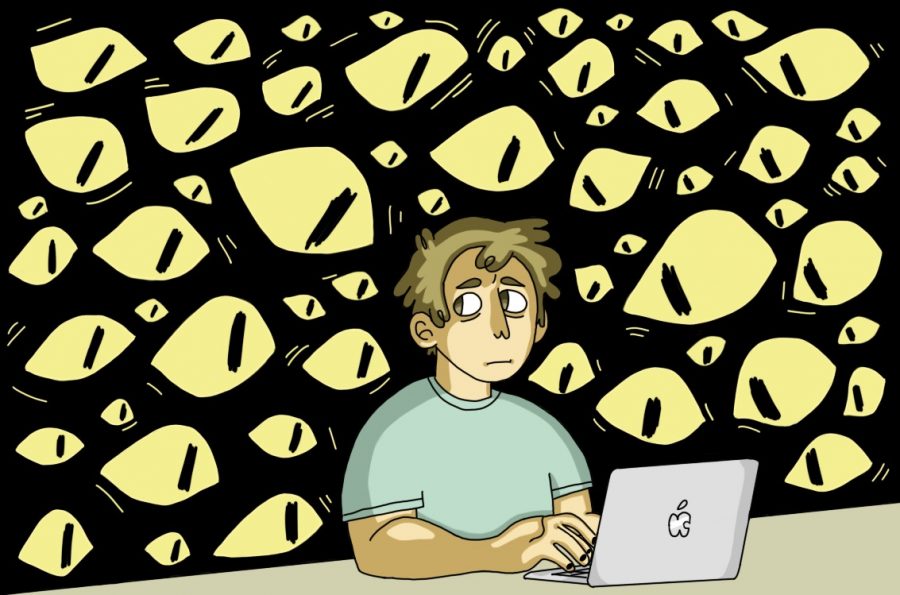
One theory is that consciousness is an innate trait of any feedback network; from bacteria, to humans, and all life in between.
This does not imply that a tree will be able to look at itself in a mirror and say “I am”. Just as our conscious state is limited by our sensory perception, so is the tree’s. The tree cannot necessarily see, but it can detect sunlight, nutrients, and potential obstacles; able to adjust itself to its own environment. Plants have even been shown to communicate with each other, suggesting a limited form of conscious ability (5 ). This same idea applies to any living being and potentially even all physical elements.
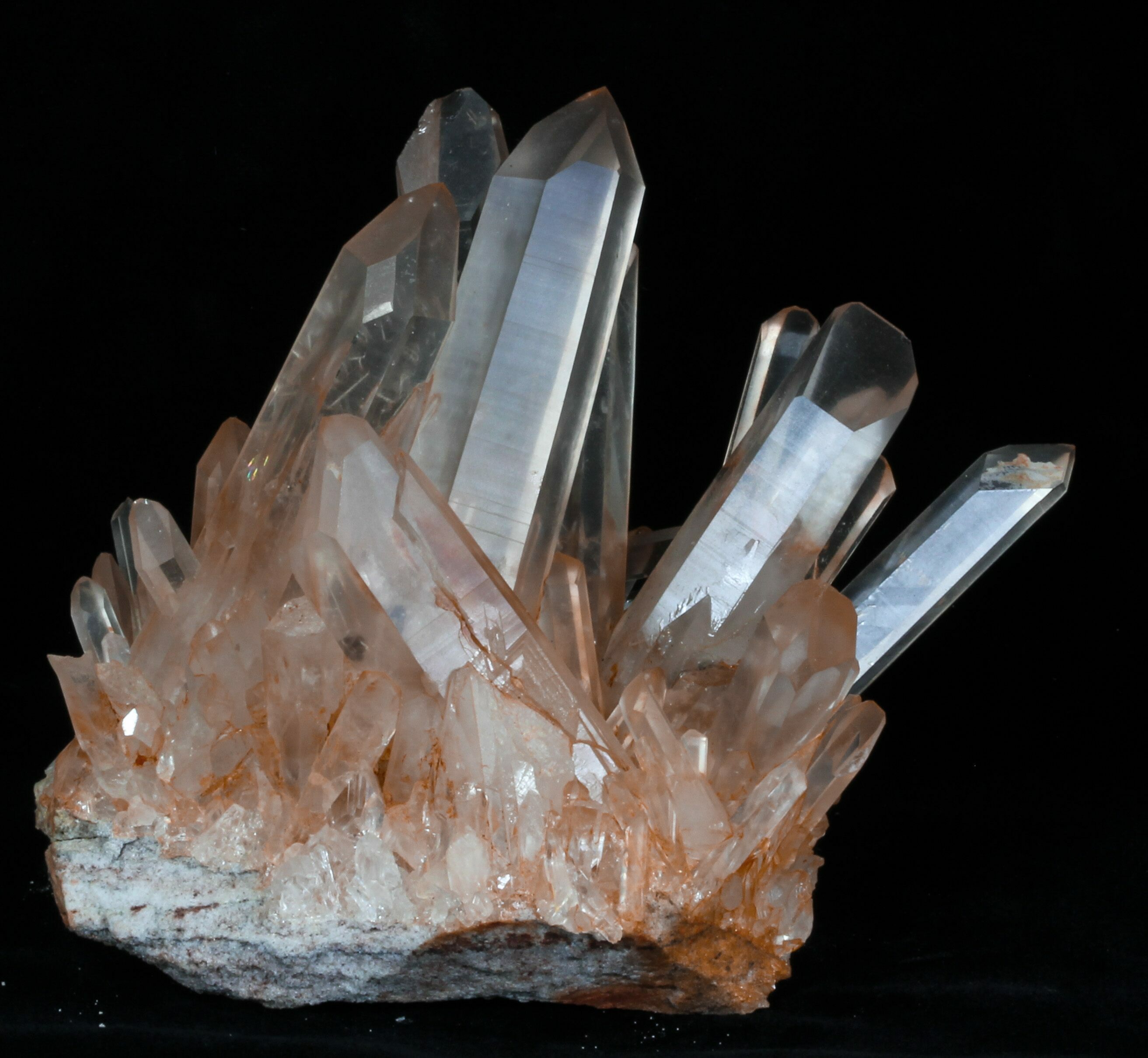
Yes, even basic elements can be considered conscious to an incredibly small degree. If you watch real-time formation of any crystalline structure you can find repeating patterns within the process. When forming, the crystal repeats a certain nuclear geometry that appears to take on recognizable and repeatable shapes and forms. The shape will continue to form until a foreign obstacle (another element or mineral) is encountered; when that occurs the structure simply builds around it. The repeatable nature of these forms suggests some sort of intelligent, innate, programming. Better yet, the reaction to the environment shows that even at the atomic level there is a rudimentary form of awareness.
Biological entities are then feedback mechanisms upon feedback mechanisms upon even more feedback mechanisms; impossibly complicated structures that are a miracle in itself. The fact that these are not random lends to the idea of something far beyond our current scientific understanding.
To be, or not to be, that is the question.
William shakespeare
Esse, “to be”, only four letters but truly infinite meaning. This begs the question of what and how we are anything. Technically speaking we are always living in the past; the split second necessary for environmental perception within the brain leaves us always just a partial step behind reality.
Though our vocabulary limits us in thought formulation, we all know what it means to be. We have all experienced from time to time the pause in the constant stream of thought, and the sheer simple joy of living is felt within you. Depending on the individual this will be experienced at different times in different places. This event is commonly referred to as “enlightenment” or “God”. Regardless of the label attached to it, the experience is the same across humanity.
Materialistic thinking lends to the idea that consciousness is strictly a product of the brain and the innumerable chemical and electromagnetic reactions within it. Although this sounds simple it does not answer the question of the nature or origin of being, just the physical expression of it. Instead, current thought strays strictly towards describing the expressions of this reality alone.
When 99.99999% of what is considered to be “solid”, is just empty space (6), why are we fixated on the infinitesimally small amount of what appears to be solid? Many people are familiar with Einstein’s energy mass equivalence which commonly appears as E=m(c^2). This equation demonstrates that the mass and total energy of the object are directly related to one another.
E=m(c^2) : m=E/(c^2)
Matter is then just a property of energy, the more mass an object has, the more potential energy is inside it. Mass is an illusion, nothing but a manifestation of energy itself. What we perceive to be solid is just energy existing in another state. That is, in part, how the atomic bomb was first developed; people realized that there is an immense amount of energy stored within nuclear bonds, especially in elements with a large atomic mass.

Picture a whirlpool within liquid. The whirlpool itself doesn’t really exist but only appears because of the action of the liquid. Perhaps this is a metaphor to what we are, an expression of what surround us.
What this means is that you and I are nothing more than energy oscillating at differing rates. If so, how is our brain the creator of our own awareness? The chemical and energetic structure of the body and brain is surprisingly similar to that of a potato; though we appear and act vastly different from our potato brethren. We must continue to look for the answer outside of the body, in the vast reaches of what we perceive to be empty space.
John Wheeler
No point is more central than this, that space is not empty, it is the seat of the most violent physics
For many, it is believed that consciousness is a result of the brain, ceasing to exist when we die. Looking for the consciousness in the brain is akin to looking for the singer inside of your speakers. Your body is but an antenna that tunes itself to the cosmic frequencies of the universe. With help of the pineal gland, and the sensitive crystalline structures within it, the human brain and body are able to access higher vibrational states of being– whether materialist science knows this or not. Time, and more research will lend credence to this subject. A subject that is dearly important to each and every one of us.
References
- projects, C. to W. (2019, April 25). German theoretical physicist. Retrieved from https://en.wikiquote.org/wiki/Max_Planck
- Starr, Cecie (2005). Biology: Concepts and Applications. Thomson Brooks/Cole. ISBN978-0-534-46226-0.
- Can Dogs See Colors? (n.d.). Retrieved from https://www.psychologytoday.com/us/blog/canine-corner/200810/can-dogs-see-colors
- Weizmann Institute Of Science (27 February 1998). “Quantum Theory Demonstrated: Observation Affects Reality”. Science Daily.
- Devlin, H. (2018, May 2). Plants ‘talk to’ each other through their roots. Retrieved from https://www.theguardian.com/science/2018/may/02/plants-talk-to-each-other-through-their-roots
- Sundermier, A. (2016, September 23). 99.9999999% of your body is empty space. Retrieved from https://www.businessinsider.com.au/physics-atoms-empty-space-2016-9

 Health For Life